Stuck powder
The laser melts a pool of steel about 0.1 mm wide. Grains of powder touching its edge half-melt and stick. On side walls and undersides they cover the surface; blasting knocks most of them off.
A laser-printed part is not shiny. It comes off the printer with a fine, sandy skin of half-melted powder, and we bead-blast it to an even satin grey. Zoom in on each kind of face below, from how it looks in your hand to what a microscope sees.
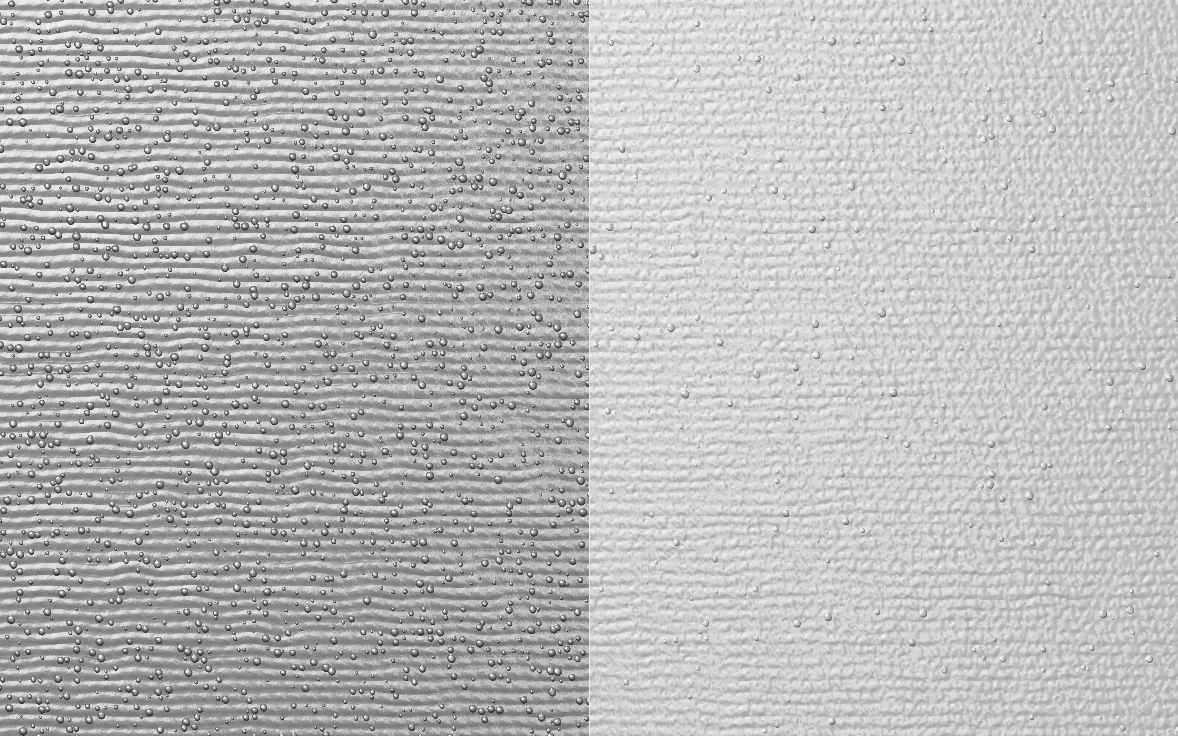
A vertical wall. Each layer leaves a faint line; grains of half-melted powder stick all over it. This is most of the surface on most parts.
Drawn from a model of the surface at true scale: powder grains 15 to 45 µm, layers 30 or 60 µm, melt tracks 0.09 mm apart, support teeth on a 1 mm grid, pores 0.2 % of the area. Roughness values are typical of laser powder-bed 316L in published studies; every part varies with its shape and how it stood on the printer. Real photos of our parts will be added when the printer is running.
Ra is the average height of the roughness, in thousandths of a millimetre (µm). For scale, a human hair is about 70 µm thick.
| Finish | Top faces | Side walls | Gentle slopes | Undersides | What it is |
|---|---|---|---|---|---|
| As printed | 6–10 µm | 8–14 µm | 12–20 µm | 20–35 µm | Dull grey with grains of powder stuck on. Never shipped like this. |
| Bead-blasted (standard) | 3–5 µm | 4–7 µm | 7–12 µm | 12–20 µm | Fine glass beads knock off the loose grains and leave an even satin matte. Included. |
| Tumbled (+$6) | 1.5–3 µm | 2–4 µm | 4–8 µm | 8–14 µm | Hours in a tumbler with ceramic media: rounder edges, a soft sheen. Still not shiny. |
| Mirror polish | under 0.2 µm | Hand polishing. We do not offer it: it rounds fine detail and costs more than the part. You can polish visible faces yourself. | |||
Three things make a printed surface, and the close-up shows each.
The laser melts a pool of steel about 0.1 mm wide. Grains of powder touching its edge half-melt and stick. On side walls and undersides they cover the surface; blasting knocks most of them off.
A slope is built as a stair of thin layers. On steep walls the steps are tiny; on a face leaning only a little, each step shows as a fine line you can feel. Fine layers halve the step.
Faces that point down are printed on thin supports that we cut off afterwards. They leave a grid of rough ridges. Put the faces you will look at on top or on the sides.
On faces that point up, the last layer shows the laser's path: rows 0.09 mm apart with fine ripples, like a fish-scale pattern, visible at an angle to the light.
Not as a service. Tumbling gives a soft sheen; a mirror finish needs hand polishing, which rounds small details and costs more than most parts. Polishing the faces you care about yourself works well: start at 400 grit and finish with metal polish.
316L is the stainless steel used for boat fittings. Printed parts resist rust like the bar steel does. The grainy surface holds dirt more than polished steel, so rinse salt and food off.
Yes, with heat. Stainless steel turns straw, gold, bronze, purple and then blue as it is heated from about 300 to 600 °C. An oven's self-clean cycle gives gold to bronze; a small kiln gives the bluer colors repeatably. The color is a thin oxide layer that does not rub off with handling.
Bead-blasted, it feels like a fine matte tool handle: smooth to the hand, with a faint grain under a fingernail. Undersides where supports were feel coarser.